


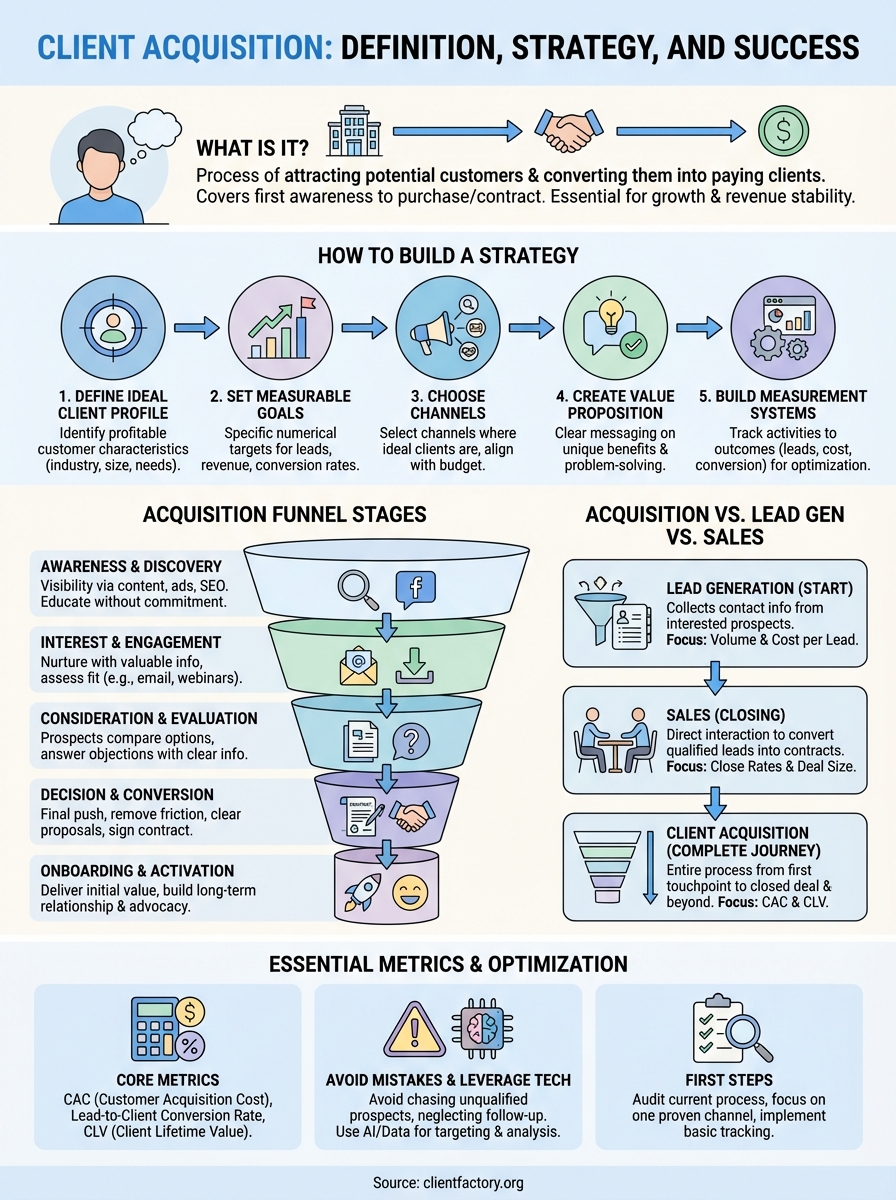
Client acquisition is the process of attracting potential customers and converting them into paying clients. It covers everything from the first moment someone learns about your business to the point where they make a purchase or sign a contract. Every marketing campaign, sales conversation, and follow-up email that helps bring new customers through your door is part of client acquisition. The term applies to all businesses but matters most to service companies and professional firms where each new client represents significant revenue potential.
This article explains what client acquisition means and how it works. You’ll see the difference between client acquisition, lead generation, and sales. We’ll walk through the key stages of the acquisition funnel and examine the channels and metrics that matter most. You’ll find practical examples from service businesses, learn common mistakes to avoid, and discover how data and AI can strengthen your approach. By the end, you’ll understand how to build a client acquisition strategy that brings predictable growth to your business.
Why client acquisition matters for business growth
Your business survives on new customers. Without a steady flow of clients, you face revenue decline and eventual closure, no matter how well you serve existing customers. The client acquisition definition centers on this fundamental truth: growth requires bringing new paying customers into your business at a rate that exceeds natural attrition. You need new clients to replace those who leave, expand into new markets, and increase your market share against competitors who actively pursue the same prospects.
Revenue stability and predictability
Client acquisition creates financial predictability that allows you to plan and invest in growth. When you establish repeatable systems for attracting and converting prospects, you gain control over your revenue pipeline. You can forecast future income, hire additional staff, expand service offerings, and make strategic investments with confidence. Businesses that rely solely on referrals or word-of-mouth face unpredictable revenue fluctuations that make planning nearly impossible. A structured acquisition strategy transforms your business from reactive to proactive, giving you the ability to scale when opportunities arise.
Consistent client acquisition transforms your business from hoping for growth to engineering it.
Market expansion and competitive advantage
Strong client acquisition capabilities allow you to enter new markets and serve different customer segments without gambling your business. You can test new service offerings, geographic markets, or customer types by directing acquisition efforts toward specific targets. Your competitors actively pursue the same prospects you need, making acquisition a competitive necessity rather than a choice. Companies that excel at client acquisition capture market share faster, establish category leadership, and create barriers that protect their position. You build brand recognition through acquisition activities, making future acquisition easier and less expensive as prospects already know your name when they need your services.
How to build a client acquisition strategy
Building a client acquisition strategy requires deliberate planning rather than random marketing activities. You need a structured approach that identifies your ideal clients, selects the right channels to reach them, and creates repeatable processes for conversion. A solid strategy connects every acquisition activity to measurable business outcomes, allowing you to allocate resources wisely and scale what works. The process starts with understanding who you want to acquire and ends with systems that deliver clients predictably.
Define your ideal client profile
Your acquisition strategy begins with precise identification of who you want as clients. You need to document the characteristics of your most profitable customers: their industry, company size, annual revenue, challenges they face, and decision-making process. This profile guides every acquisition decision you make, from the content you create to the channels you use. Businesses that skip this step waste resources attracting prospects who never convert or become unprofitable clients after signing. Your ideal client profile answers questions about who has the budget to pay you, experiences the problems you solve most effectively, and fits your service delivery model. Detailed profiles prevent you from chasing every possible lead and help you focus acquisition efforts where they generate the highest return.

Set measurable acquisition goals
Effective strategies include specific numerical targets for both inputs and outputs across your acquisition funnel. You should set goals for how many new clients you need each month, the revenue they represent, and the intermediate metrics that predict success, such as qualified leads generated or discovery calls booked. These targets emerge from your business growth objectives and inform budget allocation across channels. Vague goals like "get more clients" provide no guidance for day-to-day decisions or resource investment. Calculate how many prospects you need at each funnel stage to hit your client targets, working backward from your close rate and average deal size. Goals create accountability and reveal which acquisition activities deserve more investment versus which ones drain resources without delivering results.
Strategy without measurable goals becomes activity without direction.
Choose your acquisition channels
Your channel selection depends on where your ideal clients spend attention and what aligns with your budget and capabilities. Service businesses typically succeed with channels like search engine optimization, paid advertising, content marketing, email outreach, partnerships, and speaking engagements. You should start with two or three channels rather than spreading resources across everything, allowing you to build competence and gather meaningful data about performance. Each channel requires different skills, timelines, and investment levels, making your ideal client profile and budget the primary selection criteria. Channels like SEO demand patience but deliver compounding returns, while paid advertising produces immediate results at ongoing cost. Test channels systematically, measuring cost per acquisition and client lifetime value before scaling investment.
Create your value proposition and messaging
Your acquisition strategy requires clear articulation of why prospects should choose your services over alternatives. You need messaging that addresses specific problems your ideal clients face and demonstrates how you solve them differently or better than competitors. This value proposition appears consistently across every acquisition touchpoint, from your website to sales conversations to email campaigns. Generic statements about quality or service fail to differentiate your business or motivate action. Research the language your ideal clients use to describe their challenges and incorporate it into your messaging. Strong value propositions connect your capabilities directly to measurable client outcomes, making the decision to engage with you obvious rather than debatable. Understanding the client acquisition definition helps you see that messaging quality directly impacts conversion rates at every funnel stage.
Build measurement and optimization systems
Your strategy needs tracking systems that connect acquisition activities to client outcomes. You should implement tools that show which channels generate qualified leads, how leads progress through your funnel, where prospects drop off, and the cost to acquire each client. This data reveals what works and what wastes money, allowing you to optimize continuously rather than guessing. Businesses that lack measurement systems repeat failing tactics while abandoning successful ones based on incomplete information. Track metrics like cost per lead, lead-to-client conversion rate, average deal size, and time to close for each acquisition channel. Regular analysis of this data informs budget reallocation, messaging refinement, and channel expansion decisions that compound your acquisition effectiveness over time.
Key stages in the client acquisition funnel
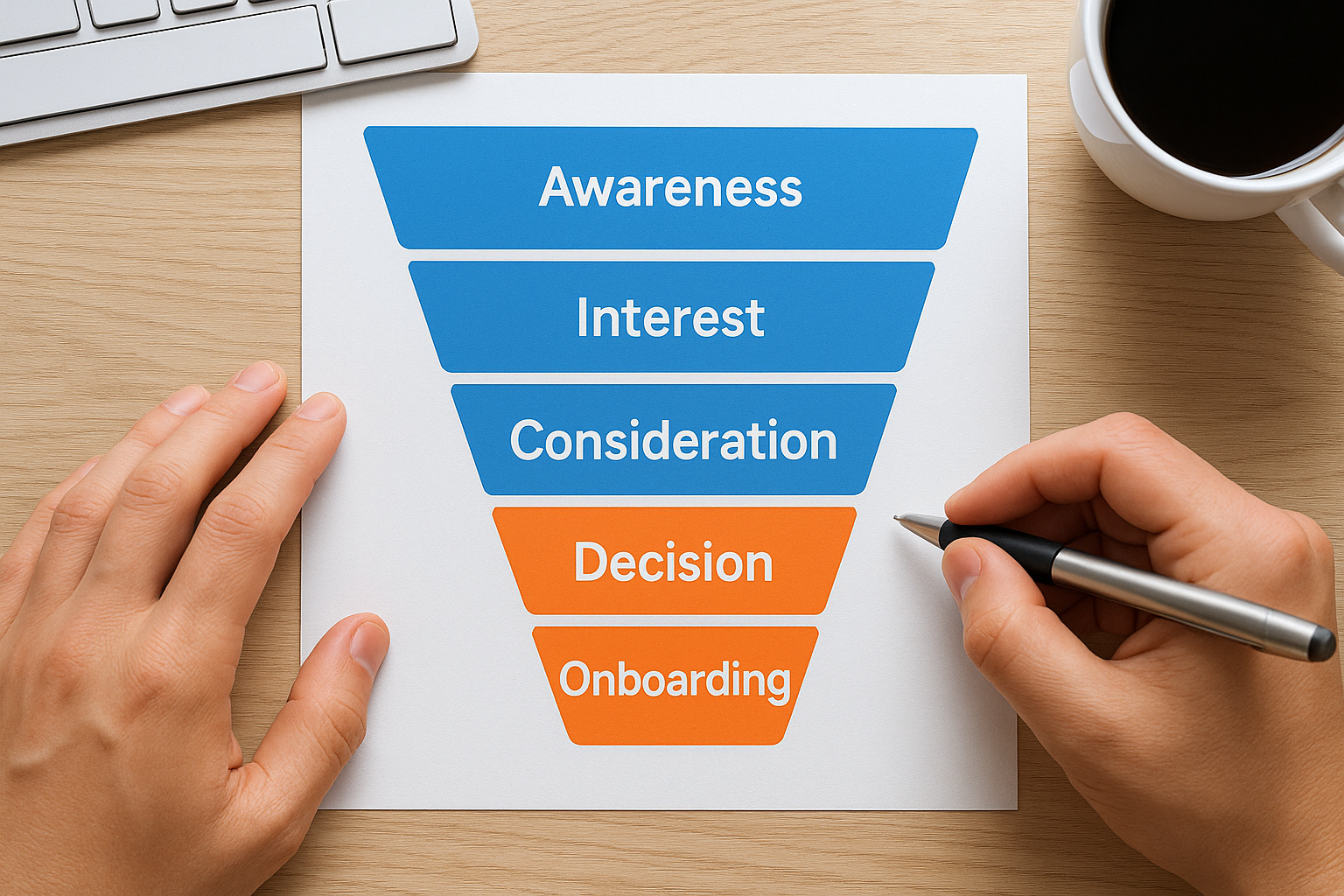
The client acquisition funnel maps the journey prospects take from first learning about your business to becoming paying clients. You need to understand each stage because different prospects require different approaches based on where they sit in this progression. The funnel visualizes how a large number of initial prospects narrows to a smaller group of qualified leads and ultimately converts to actual clients. Successful acquisition depends on your ability to move prospects smoothly from one stage to the next without losing them to confusion, competition, or indifference. The client acquisition definition encompasses this entire progression, making funnel optimization critical to sustainable growth.
Awareness and discovery
Your prospects enter the funnel when they first become aware of your business and the solutions you provide. This stage focuses on visibility and reach, where you use content marketing, advertising, search engine optimization, and social media to appear in front of people experiencing problems you solve. Prospects at this stage conduct research, compare options, and educate themselves about potential solutions. You need to provide educational content that addresses their challenges without demanding immediate commitment, building recognition and establishing credibility before asking for anything in return.
Interest and engagement
Prospects move to the interest stage when they actively engage with your content or respond to your outreach. They might subscribe to your email list, download a resource, follow your social accounts, or visit multiple pages on your website. Your goal during this stage involves nurturing relationships through valuable information that demonstrates your expertise and differentiates your approach. Engagement activities like email sequences, webinars, or discovery calls help prospects evaluate whether you understand their specific situation and can deliver results. This stage separates casual browsers from serious potential clients who deserve your acquisition resources.
Consideration and evaluation
During consideration, prospects actively compare your services against competitors and internal alternatives. They examine case studies, testimonials, pricing, and processes to determine fit and value. Your prospects want to understand implementation details, expected outcomes, and risks involved in choosing your services. You should provide detailed information that answers objections and demonstrates clear return on investment, making their evaluation process easier rather than forcing them to search elsewhere for answers.
Prospects who receive clear, honest information during evaluation convert at higher rates and stay longer as clients.
Decision and conversion
The decision stage represents the final push toward commitment, where prospects either sign contracts or walk away. Your sales process, pricing transparency, and removal of friction determine success at this critical point. Prospects need confidence that you deliver what you promise and that the process of starting work together flows smoothly. Clear proposals, simple onboarding steps, and immediate value demonstration help prospects overcome final hesitation. Conversion optimization at this stage multiplies the return on all upstream acquisition investment.
Onboarding and activation
Client acquisition extends beyond contract signature to include onboarding, where you deliver initial value and establish the foundation for long-term relationships. New clients who experience quick wins and smooth processes become advocates who refer additional prospects, reducing future acquisition costs. Poor onboarding creates buyer’s remorse and increases churn, forcing you to acquire replacement clients continuously. Strong onboarding systems maximize lifetime value and turn acquisition investment into compounding returns through referrals and expansions.
Client acquisition vs lead generation vs sales
These three terms describe different parts of the customer journey, though many people use them interchangeably. You need to understand the distinctions because each requires specific skills, resources, and measurement approaches. The client acquisition definition encompasses both lead generation and sales as components of a larger process. Lead generation fills the top of your funnel with potential prospects, sales converts qualified leads into paying customers, and client acquisition describes the entire system from first contact to closed deal. Confusing these terms leads to misaligned expectations, poor resource allocation, and communication breakdowns between marketing and sales teams.
Lead generation: The starting point
Lead generation focuses on collecting contact information from prospects who express interest in your services. You generate leads through content offers, webinar registrations, contact form submissions, or demo requests that capture names, email addresses, and basic qualification details. Marketing teams typically own lead generation activities and measure success by volume and cost per lead rather than revenue outcomes. A lead represents potential interest but not necessarily buying intent or budget, making it the earliest stage in your acquisition process. Many leads never convert to clients, which explains why businesses need substantial lead volume to achieve modest client targets.
Sales: The closing activity
Sales encompasses the direct interactions and negotiations that convert qualified prospects into signed contracts. Your sales team conducts discovery calls, delivers presentations, handles objections, and negotiates terms with prospects who have demonstrated serious buying intent. Sales activities measure success through close rates, deal size, and revenue generated rather than lead volume. The sales process begins after marketing qualifies a lead and ends when a contract signature or first payment confirms client status.
Client acquisition requires both lead generation and sales working together rather than operating as separate functions.
Client acquisition: The complete journey
Client acquisition spans from the first marketing touchpoint through contract signature and initial onboarding. You measure client acquisition by the cost to convert a stranger into a paying customer and the lifetime value that customer generates. Understanding this complete journey prevents you from optimizing one component while neglecting others, which often happens when marketing celebrates lead volume while sales struggles with low-quality prospects or when sales closes deals that churn quickly due to poor qualification upstream.
Core channels for client acquisition
You need to select acquisition channels based on where your ideal clients spend attention and what aligns with your capabilities and budget. Different channels deliver distinct advantages and challenges, making strategic selection critical to acquisition success. Service businesses typically achieve the best results by focusing resources on three to five primary channels rather than spreading efforts across every possible option. Each channel operates with unique cost structures, timelines, and skill requirements that affect both short-term results and long-term sustainability. The client acquisition definition includes understanding which channels connect you most effectively with prospects who match your ideal client profile.
Search engine optimization and content marketing
Search engine optimization positions your website to appear when prospects search for solutions to problems you solve. You create high-quality content that answers specific questions your ideal clients ask, building authority and trust before prospects ever contact you. Content marketing includes blog articles, guides, videos, and resources that demonstrate expertise while attracting organic traffic without ongoing advertising costs. This channel requires patience because results accumulate gradually over months, but successful SEO efforts create compounding returns as content continues attracting prospects long after publication. You gain control over your acquisition pipeline when prospects find you through search rather than depending entirely on paid channels that stop delivering the moment you pause spending.
Paid advertising platforms
Paid advertising delivers immediate visibility and traffic through platforms like Google Ads, Facebook, LinkedIn, and YouTube. You can target specific demographics, industries, job titles, and behaviors to reach precisely the prospects you want. Advertising channels provide rapid testing capabilities that reveal which messages, offers, and targeting criteria generate qualified leads most cost-effectively. The primary limitation involves ongoing costs that continue as long as you want results, making cost per acquisition and lifetime value calculations critical to sustainable profitability.
Paid advertising works best when you test aggressively, kill what fails quickly, and scale what converts profitably.
Email outreach and nurturing
Email remains one of the most effective channels for service businesses to build relationships with prospects over time. You can send personalized outreach to specific prospects, deliver educational content to subscribers, and nurture leads through automated sequences that guide them toward booking calls or requesting proposals. Email provides direct access to prospects without algorithm changes or platform restrictions affecting delivery. Strong email strategies combine cold outreach to new prospects with nurturing campaigns for existing leads, creating multiple touchpoints that build familiarity and trust before asking for commitments.
Referrals and partnerships
Referral channels leverage existing clients, professional contacts, and strategic partners who recommend your services to prospects they know. You can establish formal referral programs with incentives or rely on organic recommendations from satisfied clients who naturally share their positive experiences. Partnership channels involve collaboration with complementary businesses that serve your ideal clients but don’t compete directly with your services. These warm introductions convert at higher rates than cold outreach because prospects receive built-in credibility through trusted recommendations.
Speaking and thought leadership
Speaking opportunities at conferences, webinars, podcasts, and industry events position you as an expert authority while exposing you to concentrated groups of ideal prospects. You demonstrate expertise directly rather than asking prospects to trust written claims, building immediate credibility that shortens sales cycles. Thought leadership through contributed articles, media interviews, and public commentary extends your reach beyond direct audience sizes as others share and reference your ideas. This channel requires strong communication skills and consistent effort to secure opportunities, but successful implementation creates acquisition momentum that builds on itself over time.
Essential metrics for client acquisition
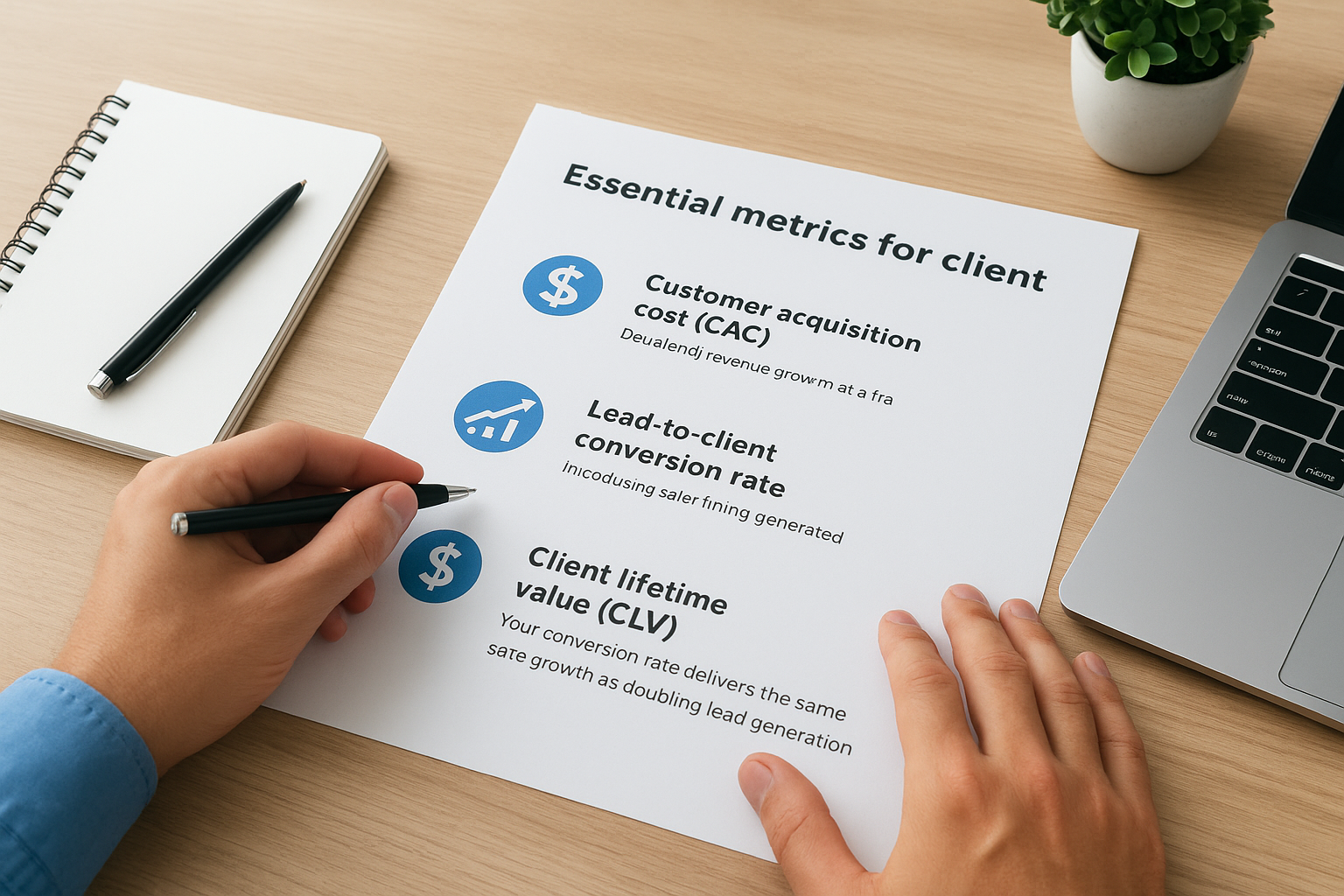
You need specific metrics to determine whether your acquisition efforts generate profit or drain resources without return. Tracking the right numbers separates effective acquisition strategies from expensive guessing games that burn budgets while delivering mediocre results. The metrics you measure determine which channels deserve more investment, which messages convert prospects most effectively, and whether your acquisition costs align with the revenue each client generates. Understanding the client acquisition definition requires mastering these core measurements that connect marketing activities to business outcomes. Businesses that ignore metrics repeat failing tactics while abandoning successful ones based on incomplete information or gut feelings rather than data.
Customer acquisition cost (CAC)
Customer acquisition cost measures the total expense required to convert a prospect into a paying client. You calculate CAC by dividing all acquisition costs, including advertising, marketing salaries, tools, and sales commissions, by the number of new clients acquired during a specific period. A service business that spends $10,000 on acquisition activities in one month and closes five new clients faces a CAC of $2,000 per client. This metric reveals whether you can afford to acquire clients at current spending levels and which channels deliver the lowest cost per acquisition. You should track CAC separately for each acquisition channel because costs vary dramatically between search advertising, content marketing, and referral programs.
Lead-to-client conversion rate
Your conversion rate shows what percentage of leads become paying clients, revealing how effectively your sales process and qualification criteria perform. You calculate this metric by dividing new clients by total qualified leads generated during a period. A business that generates 100 qualified leads and closes 10 clients operates at a 10% conversion rate, indicating that 90% of prospects exit the funnel before purchasing. Low conversion rates signal problems with lead quality, sales approach, pricing, or message-market fit that require immediate attention.
Improving conversion rate delivers the same revenue growth as doubling lead generation at a fraction of the cost.
Client lifetime value (CLV)
Client lifetime value estimates the total revenue you expect from a client throughout your entire relationship. You calculate CLV by multiplying average client revenue per year by the typical number of years clients stay with your business. Service businesses with recurring revenue models often generate CLV figures that justify higher acquisition costs than transaction-based competitors. A law firm client who pays $5,000 annually for five years delivers $25,000 in lifetime value, making a $2,000 acquisition cost highly profitable. You compare CLV to CAC to ensure sustainable acquisition economics, targeting ratios where lifetime value exceeds acquisition cost by at least 3:1 to account for operating expenses and profit margins.
Client acquisition examples for service businesses
Service businesses acquire clients through targeted approaches that match how their ideal customers make buying decisions. You can learn from real-world examples that demonstrate how the client acquisition definition applies across different industries and service types. Each example reveals specific tactics and channels that converted prospects into paying clients, showing you patterns you can adapt to your own business. These examples span different service categories, budgets, and growth stages to provide actionable insights regardless of your current situation.
Law firm acquiring personal injury clients
A personal injury law firm uses paid search advertising to capture prospects actively searching for legal representation after accidents. You see this approach when someone searches for "car accident lawyer near me" and finds sponsored listings at the top of results. The firm directs clicks to a dedicated landing page that explains their process, displays past case results, and offers a free consultation with a simple contact form. They track phone calls and form submissions as leads, following up within minutes to schedule consultations. Their sales team closes approximately 30% of consultations into signed representation agreements, with each client generating an average of $15,000 in fees. The firm calculates that spending $500 to acquire a client who delivers $15,000 provides excellent acquisition economics, allowing them to outbid competitors for top advertising positions while maintaining profitability.
Marketing agency building pipeline through content
A digital marketing agency attracts clients by publishing educational content that addresses specific challenges their prospects face. You observe their strategy through weekly blog posts, YouTube videos, and LinkedIn articles that demonstrate expertise in client acquisition, conversion optimization, and campaign management. Prospects discover this content through organic search and social media, subscribing to the agency’s email list to receive additional resources. The agency nurtures these subscribers through an automated email sequence that shares case studies, offers free audits, and eventually invites prospects to schedule strategy calls. Approximately 5% of email subscribers book calls, with 40% of those calls converting into contracts worth $3,000 to $10,000 monthly. This content-driven approach requires consistent effort but delivers compounding returns as older content continues attracting prospects without ongoing costs.
Content-based acquisition transforms your expertise into a client generation system that works while you sleep.
Consulting firm leveraging partnerships
A business consulting firm acquires clients through strategic partnerships with complementary service providers who serve the same target market. You implement this approach by identifying accountants, lawyers, and software vendors who work with your ideal clients but don’t offer competing services. The firm provides partners with clear referral criteria and offers reciprocal introductions when appropriate, creating mutual benefit rather than one-sided requests. When partners identify clients facing challenges the consulting firm solves, they make warm introductions that convert at rates above 60% because prospects receive built-in credibility through trusted recommendations. Each referred client generates average fees of $25,000, making partner relationship management a high-return acquisition channel that scales through additional partnerships rather than increased spending.
Common client acquisition mistakes to avoid
You sabotage your acquisition efforts by repeating common mistakes that waste resources and repel qualified prospects. Understanding what failures to avoid matters as much as knowing which tactics to implement, because wrong approaches drain budgets faster than right approaches generate returns. The client acquisition definition includes recognizing that acquisition success depends as much on eliminating destructive habits as on executing smart strategies. You can accelerate growth by identifying these mistakes in your current approach and correcting them before they consume additional time and money.
Chasing unqualified prospects
You hurt your business when you pursue prospects who lack the budget, authority, need, or timeline to become profitable clients. Many businesses generate large volumes of low-quality leads that consume sales time without converting, creating the illusion of activity while delivering poor results. You should establish clear qualification criteria before investing resources in pursuing any prospect, filtering out those who fail to meet minimum standards. Businesses that chase every possible lead discover that conversion rates collapse and customer acquisition costs skyrocket because most prospects never intended to buy. Target your acquisition efforts toward prospects who match your ideal client profile rather than casting wide nets that catch mostly unsuitable leads.
Neglecting follow-up systems
You lose 80% of potential clients by failing to follow up consistently after initial contact. Most prospects require multiple touchpoints before they commit to purchasing, yet businesses often contact prospects once or twice before abandoning them entirely. You need automated systems that continue nurturing leads through email sequences, retargeting ads, and scheduled outreach until prospects either convert or explicitly opt out.
Consistent follow-up transforms prospects who said "not now" into clients who say "yes" when timing aligns.
Spreading resources too thin
You diminish results when you attempt too many acquisition channels simultaneously without mastering any. Businesses often allocate small budgets across five or six channels, generating insufficient data to determine what works and preventing expertise development in any single approach. You should concentrate resources on two or three primary channels until you achieve predictable, profitable results before expanding to additional options.
Using data and AI to improve client acquisition
You gain significant advantages by applying data analysis and artificial intelligence to your acquisition process. Modern acquisition strategies depend on systematic data collection that reveals which prospects convert, what messages resonate, and where resources deliver the strongest returns. You can track every interaction from first website visit through signed contract, identifying patterns that predict success or failure at each funnel stage. Artificial intelligence amplifies your capabilities by processing larger datasets than human teams can analyze, spotting subtle correlations, and automating decisions that improve results continuously. Businesses that embrace these technologies acquire clients more efficiently while competitors still rely on intuition and outdated approaches.
Tracking and analyzing acquisition data
You should implement tracking systems that connect every acquisition touchpoint to revenue outcomes. Your analytics platforms need to show which marketing channels generate leads, how those leads progress through your funnel, where prospects abandon the process, and what each client costs to acquire. This data reveals performance patterns that inform budget allocation and strategy refinement. You can identify that LinkedIn generates higher-quality leads than Facebook despite lower volume, or that prospects who watch your case study video convert at twice the rate of those who skip it. Tracking systems prevent you from continuing expensive tactics that fail while providing evidence to scale approaches that work. The client acquisition definition expands beyond theory when you measure actual results and optimize based on performance data rather than assumptions.
AI-powered targeting and personalization
Artificial intelligence improves your ability to identify ideal prospects and deliver personalized messages that increase conversion rates. You can deploy AI tools that analyze thousands of data points to predict which prospects most closely match your successful client profile, allowing you to focus outreach on those with highest conversion probability. AI systems personalize email content, ad copy, and website experiences based on individual prospect behavior and characteristics, delivering relevant messages automatically rather than forcing you to manually customize every interaction.

AI transforms acquisition from broadcasting generic messages to delivering personalized experiences at scale.
Predictive analytics for better decisions
Predictive analytics uses historical data to forecast future outcomes, helping you make smarter acquisition decisions before investing resources. You can predict which lead sources will deliver the lowest acquisition costs next quarter, which prospects currently in your pipeline will most likely convert, and what offer variations will generate the highest response rates. These insights allow you to allocate budgets proactively rather than reactively, testing strategies with higher confidence and avoiding expensive mistakes that competitors make through trial and error.
Simple first steps to improve client acquisition
You can start improving your client acquisition results today without overhauling your entire marketing operation or spending significant money. Small, focused changes often deliver immediate improvements while you develop more sophisticated systems over time. The client acquisition definition becomes practical when you move from understanding concepts to taking concrete actions that generate measurable results. These first steps help you identify what currently works, eliminate obvious problems, and establish foundations for sustainable growth.
Audit your current acquisition process
You need to document exactly how prospects currently find you and what happens after initial contact. Track where your last ten clients originated, what touchpoints they experienced before purchasing, and how long the process took from first contact to signed contract. This audit reveals which channels already work and where prospects abandon your funnel most frequently. Write down every step in your current process, identifying gaps where prospects receive no follow-up or encounter confusing next steps. Most businesses discover significant opportunities simply by mapping what actually happens versus what they assume occurs.
Focus on one proven channel
You should concentrate resources on the single acquisition channel that already generates clients rather than testing multiple new approaches simultaneously. Double your investment in what works, whether that means creating more content, increasing advertising budgets, or expanding partnership outreach. This focused approach delivers faster results because you optimize existing systems rather than building from scratch. Test improvements systematically by changing one variable at a time, measuring impact before making additional adjustments.
Improving what already works generates faster returns than starting completely new acquisition channels.
Implement basic tracking
You must know which acquisition activities produce clients and what each client costs to acquire. Set up simple spreadsheets that record lead sources, conversion rates, and acquisition costs for each channel you use. This baseline measurement reveals performance patterns that guide future decisions and prevent budget waste on failing tactics.
Bringing it all together
The client acquisition definition covers the complete journey from first prospect contact to signed contracts and successful onboarding. You now understand that acquisition requires strategic planning across multiple stages, channels, and metrics rather than random marketing activities. Your success depends on defining ideal clients clearly, selecting appropriate channels, measuring performance accurately, and optimizing based on data rather than assumptions. Businesses that treat acquisition as a systematic process generate predictable growth while competitors struggle with inconsistent results and wasted resources.
Strong acquisition strategies combine proven fundamentals with modern technologies like AI and analytics that multiply your effectiveness. You should start by auditing your current process, focusing resources on channels that already work, and implementing basic tracking before expanding to sophisticated approaches. Every improvement you make reduces the cost to acquire each client while increasing the lifetime value they generate, creating compounding returns that accelerate growth. When you need expert help building acquisition systems that deliver consistent results, Client Factory specializes in transforming clicks into clients for service businesses and law firms through data-driven strategies that maximize your return on every marketing dollar invested.