
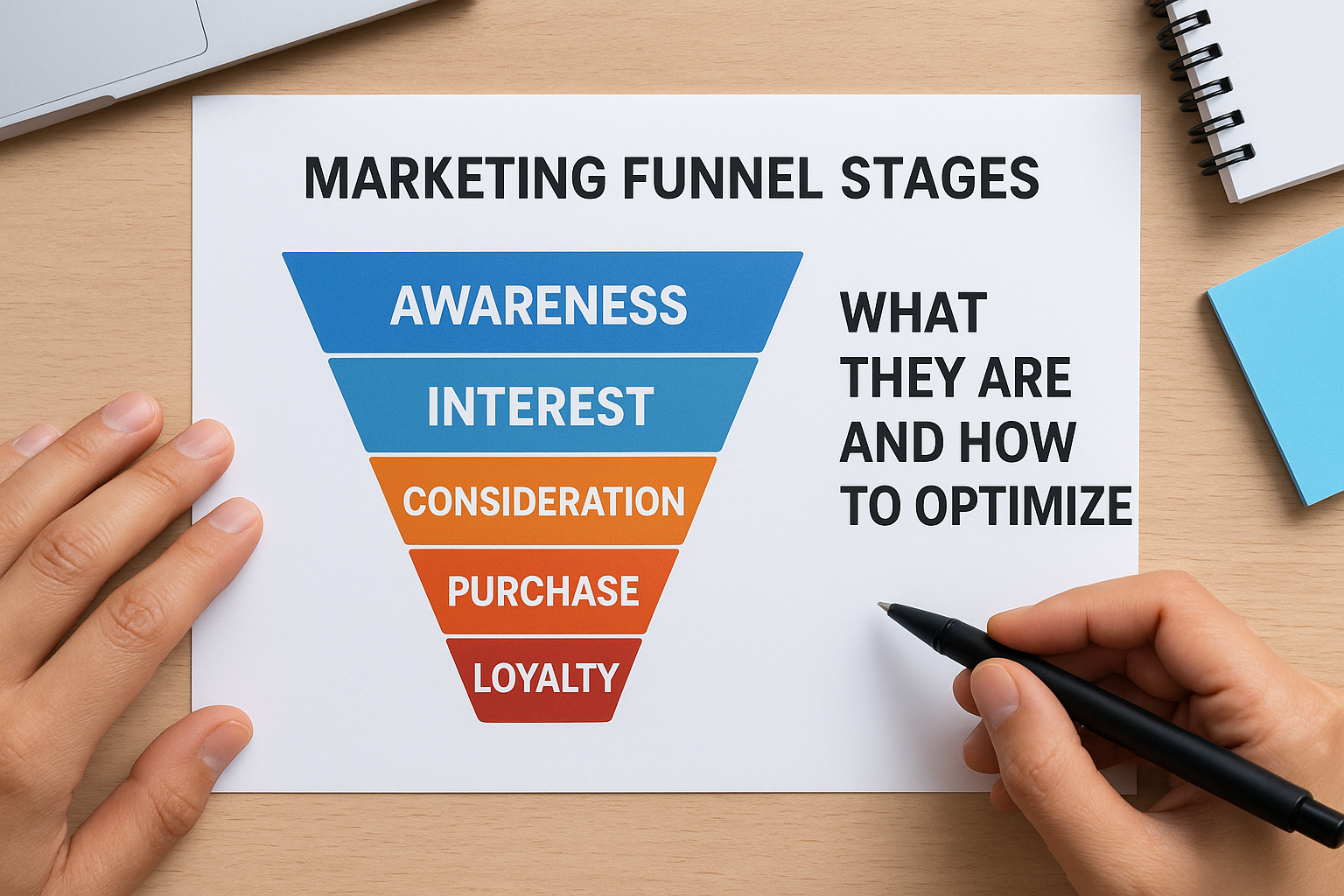
Marketing funnel stages represent the steps your potential clients take from first hearing about your business to becoming paying customers. Think of it as a roadmap that shows how people move through awareness, interest, consideration, and decision phases before they buy. Each stage requires different content and strategies because someone just discovering your service needs different information than someone ready to sign a contract.
This guide breaks down each marketing funnel stage so you can identify where prospects drop off and what content moves them forward. You will learn how to map your funnel stages, track the metrics that matter, and optimize each phase with targeted campaigns. We will also cover common mistakes that sabotage conversions and show real examples from service businesses and law firms. By the end, you will know exactly how to build a funnel that turns more prospects into clients.
Why marketing funnel stages matter
Your marketing budget goes further when you know exactly where prospects are in their decision process. Without understanding marketing funnel stages, you waste money sending the wrong message at the wrong time. A prospect researching options needs educational content, not a hard sell, while someone ready to buy needs clear next steps and pricing. Most businesses lose qualified leads because they treat everyone the same instead of matching content to the buyer’s stage.
Stages reveal where prospects drop off
Your analytics show traffic numbers, but marketing funnel stages tell you where people lose interest or get confused. When you track stage-by-stage movement, you spot patterns like prospects who research your services but never request a consultation. This visibility helps you fix specific problems rather than guessing why conversions stay low. Service businesses often discover their middle-stage content fails to address common objections, leaving prospects to seek answers elsewhere.
Understanding which stage loses the most prospects tells you exactly where to focus your optimization efforts.
Personalized messaging increases conversion rates
Generic marketing messages fail because they ignore where someone stands in their buying journey. Targeted content that matches each funnel stage produces higher engagement and conversion rates because it answers the exact questions prospects have right now. Someone in the awareness stage wants to understand their problem, while someone in the consideration stage needs proof your solution works better than alternatives. Law firms that send educational guides to early-stage prospects and case results to late-stage prospects see conversion rates double compared to one-size-fits-all approaches. Your message resonates when it meets people where they are, not where you want them to be.
How to map and use your marketing funnel stages
Mapping your marketing funnel stages starts with documenting every way prospects interact with your business, from first contact to final sale. You need a clear picture of all touchpoints where potential clients encounter your brand, whether through search results, social media, referrals, or paid ads. Most businesses discover they have more stages than they realized once they track the complete journey from stranger to customer. Your funnel map becomes the foundation for creating stage-specific content that guides prospects forward rather than leaving them to figure out next steps alone.
Start by identifying your customer touchpoints
List every place prospects find you and every action they take before becoming clients. Your touchpoint inventory includes website pages, landing pages, email sequences, phone calls, consultation forms, and any content downloads or resources you offer. Service businesses often find prospects visit their site multiple times, read several blog posts, and compare services before requesting a consultation. Law firms typically see potential clients check attorney profiles, read case results, and look for client reviews before making contact. Document these interaction points in order so you see the actual path people take, not the path you wish they would take.
Define what counts as progress at each stage
You cannot optimize what you cannot measure, so assign clear criteria for when someone moves from one stage to the next. A prospect enters the awareness stage when they first visit your site or engage with your content. They move to the consideration stage when they download a guide, watch a video, or spend significant time comparing your services. The final stages begin when they request pricing, schedule a consultation, or fill out a contact form. Your definitions need specificity because vague criteria like "shows interest" tell you nothing actionable about where someone stands in their decision process.
Track movement between stages
Set up tracking systems that show how many prospects advance from each stage and where drop-offs occur. Your analytics should reveal the percentage moving from awareness to consideration, consideration to decision, and decision to purchase. Most businesses lose the majority of prospects between awareness and consideration because they fail to provide enough value to justify continued attention. Law firms commonly see drop-offs right before consultation requests when prospects cannot find clear answers about process, timeline, or likely outcomes.
Tracking stage-by-stage movement reveals your biggest conversion bottlenecks so you stop guessing and start fixing real problems.
Your funnel data shows which marketing channels deliver prospects who progress furthest and which stages need immediate attention. When you spot a stage where half your prospects disappear, you know exactly where to focus optimization efforts for maximum impact.
Understanding the main marketing funnel stages
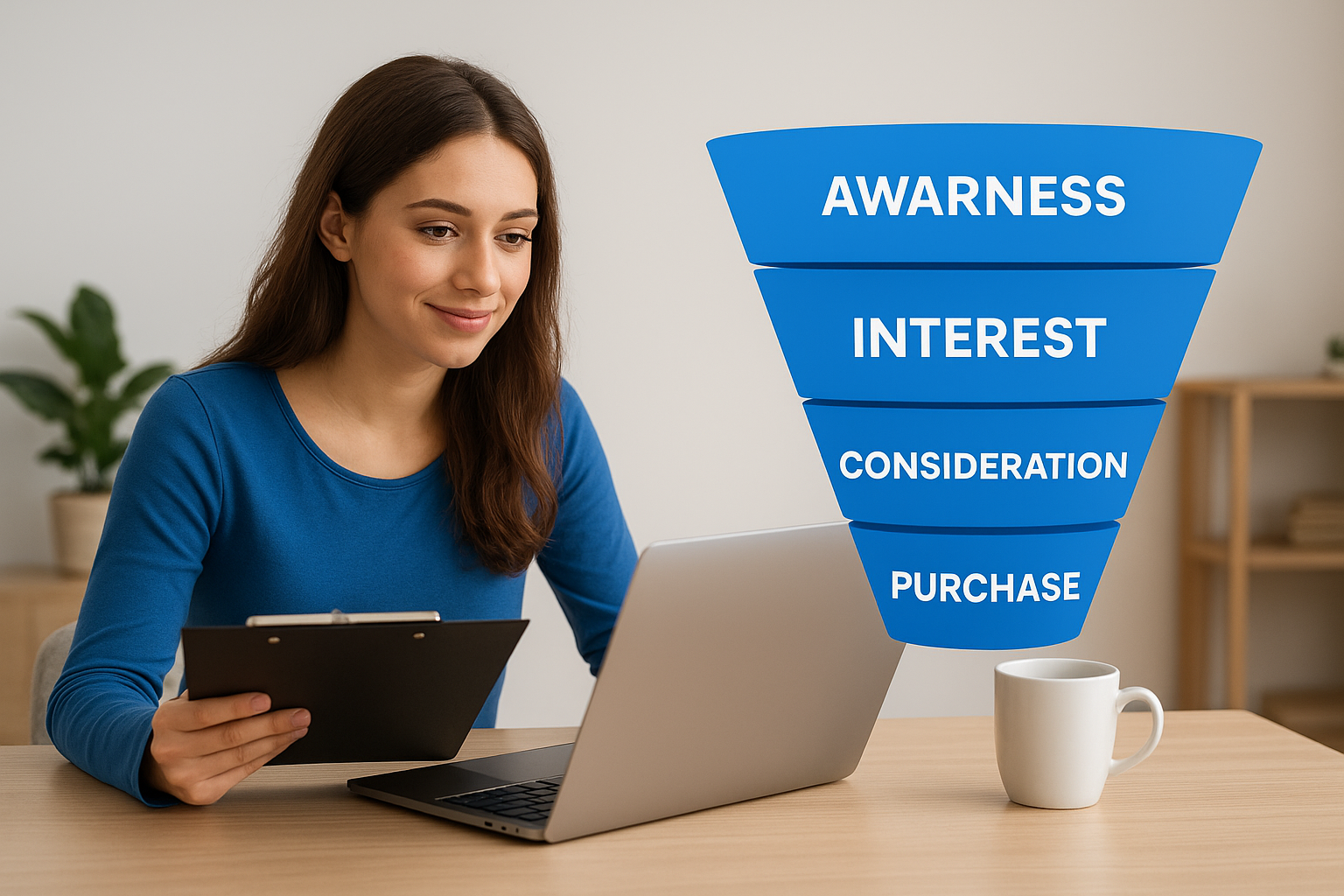
Most businesses use a five-stage marketing funnel that tracks prospects from initial discovery through purchase and beyond. These marketing funnel stages follow the AICPL model: Awareness, Interest, Consideration, Purchase, and Loyalty. Some frameworks simplify this into three stages (top, middle, and bottom of the funnel), while others expand it to include advocacy and retention. Your specific funnel structure depends on your sales cycle length and how prospects typically buy your services, but the core principle stays the same across all models.
Awareness stage (TOFU)
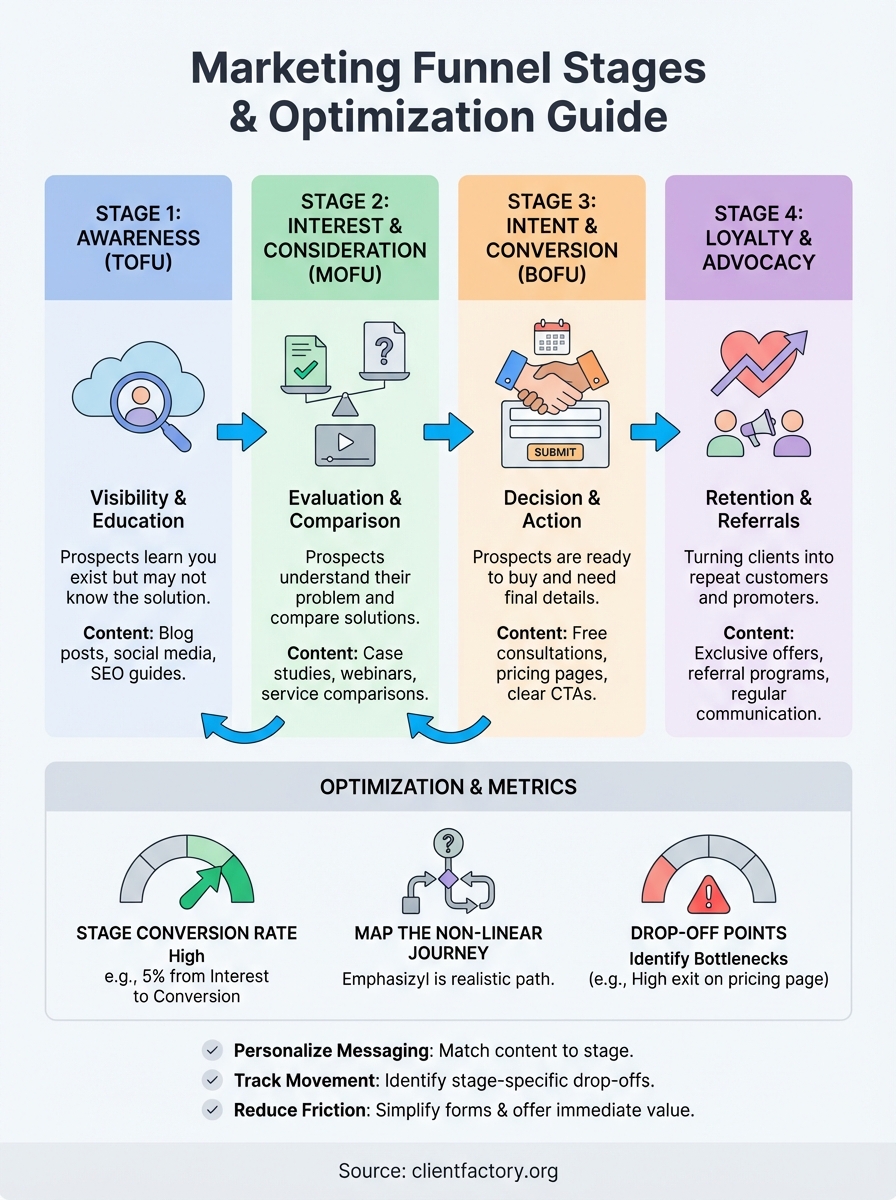
The awareness stage sits at the top of the funnel where prospects first learn your business exists. Someone in this stage recognizes they have a problem but may not know what solution they need or that your services can help. Your goal here focuses on building visibility through search engine optimization, social media presence, paid advertising, and content that educates rather than sells. Service businesses attract awareness-stage prospects with blog posts answering common industry questions, while law firms often capture attention through guides explaining legal processes or rights.
Prospects at this stage research broadly and consume educational content that helps them understand their situation. They typically visit multiple websites, read several articles, and explore various solutions before narrowing their options. Your conversion goal here involves getting them to engage further by subscribing to your email list, downloading a resource, or returning to your site for additional information.
Interest and consideration stages (MOFU)
Prospects enter the middle of the funnel once they understand their problem and start evaluating specific solutions. The interest stage means they find your services potentially relevant, while the consideration stage involves active comparison between your business and competitors. These stages blur together because prospects often move back and forth as they gather information and weigh their options. Your content shifts from general education to specific value propositions that show why your approach works better than alternatives.
Middle-funnel prospects need detailed information about your process, pricing structure, timeline, and what makes you different. They read case studies, watch explainer videos, check client testimonials, and look for proof your solution delivers results. Service businesses should provide comparison guides and detailed service descriptions, while law firms benefit from sharing case results and attorney credentials. Your conversion goal involves moving these prospects toward requesting a consultation, quote, or demo.
Intent and conversion stages (BOFU)
The bottom of the funnel captures prospects ready to make a decision. Intent stage prospects have narrowed their choices and need final details before committing, while conversion stage prospects actively request pricing, schedule consultations, or fill out contact forms. These stages require direct response content that removes final objections and makes taking action easy. Your messaging becomes specific about next steps, what happens after they contact you, and how quickly you can help them.
Bottom-funnel prospects need clear calls to action, transparent pricing information, and immediate response to their inquiries.
Conversion optimization matters most here because small improvements produce significant revenue increases. Remove friction by simplifying contact forms, offering multiple communication channels, and responding to inquiries within minutes rather than hours. Service businesses should provide instant calendar booking for consultations, while law firms benefit from offering free case evaluations with clear qualification criteria.
Loyalty and advocacy stages
Your funnel extends beyond the first purchase to include customer retention and turning clients into promoters. The loyalty stage keeps clients coming back for additional services or renewing contracts, while the advocacy stage transforms satisfied customers into referral sources. These stages often get ignored because businesses focus solely on acquiring new clients, but existing customers cost less to serve and generate higher lifetime value. Your strategies here include regular communication, exclusive offers for repeat clients, and formal referral programs that reward advocacy.
Aligning funnel stages with the customer journey
Your marketing funnel stages need to match how customers actually move through their buying process, not how you wish they would behave. Real customer journeys rarely follow a straight path from awareness to purchase because people research in bursts, revisit earlier stages, and jump between different information sources. Most businesses build funnels based on theory while their prospects follow unpredictable patterns that include multiple site visits, competitor comparisons, and long gaps between touchpoints. You align your funnel by mapping actual customer behavior instead of forcing prospects into predefined stages.
Map touchpoints to actual buying behavior
Your customer journey includes every interaction point where prospects engage with your brand, gather information, or make progress toward a decision. Start by interviewing recent clients about how they found you, what content they consumed, how long they researched, and what finally convinced them to buy. Service businesses often discover prospects read multiple blog posts over several weeks before requesting a consultation, while law firms find potential clients check reviews on external sites before ever visiting the firm’s website. Your touchpoint mapping reveals the messy reality of how people actually buy rather than the clean linear path your funnel diagram suggests.
Track which content pieces prospects consume at each stage and in what order. You might assume someone reads your service overview page first, but data often shows they land on a specific problem-focused blog post, then check pricing, then return days later to read case studies. This actual sequence tells you where to place calls to action and what content needs stronger internal linking.
Adjust content based on entry points
Prospects enter your funnel at different marketing funnel stages depending on their awareness level and how they found you. Someone searching for a specific solution enters further down the funnel than someone stumbling across your social media post. Your content needs multiple entry points that accommodate both scenarios by providing context for newcomers while offering depth for informed prospects. Law firms should include brief explainers of legal processes even in advanced content, while service businesses benefit from linking back to foundational concepts in detailed guides.
Customer journeys loop backward and forward through stages, so your content must work regardless of where someone enters or what they read next.
Design your website navigation and internal linking to support non-linear journeys by connecting related content across different funnel stages. Someone reading a consideration-stage comparison guide might need awareness-stage educational content to understand technical terms.
Funnel metrics that show what is working
Your funnel metrics tell you which marketing funnel stages convert prospects effectively and which stages leak potential clients. Most businesses track vanity metrics like total website traffic while ignoring the conversion data that reveals actual performance. You need specific measurements for each stage that show how many prospects advance versus how many disappear. Your analytics should answer whether your awareness content attracts qualified prospects, if your consideration stage builds enough trust, and where the biggest revenue opportunities hide in your funnel.
Raw numbers mean nothing without context, so compare your stage-by-stage performance against industry benchmarks and your historical data. A 3% conversion rate from awareness to consideration might sound low, but it becomes excellent if your industry average sits at 1%. Your metrics reveal trends over time that show whether optimization efforts work or new problems emerge in specific stages.
Stage-specific conversion rates
Track the percentage of prospects moving from each marketing funnel stage to the next rather than only measuring final conversions. Your awareness-to-interest conversion rate shows how well your initial content engages prospects, while your interest-to-consideration rate reveals whether your value proposition resonates. Service businesses should measure how many blog readers download guides or subscribe to email lists, then track what percentage of subscribers request consultations. Law firms benefit from tracking website visitors who check attorney profiles, then measuring how many of those profile viewers fill out case evaluation forms.
Calculate these rates by dividing the number advancing to the next stage by the total entering the current stage. Your conversion rate data pinpoints exactly which stage needs improvement rather than leaving you guessing where prospects lose interest.
Drop-off points and bottlenecks
Identify where the largest percentage of prospects exit your funnel without progressing further. Your drop-off analysis often reveals surprising problems like consideration-stage prospects who never see your pricing information or awareness-stage visitors who cannot find relevant content. Most businesses lose more prospects between interest and consideration than any other transition because this stage requires building enough trust to justify continued attention. Law firms commonly see high drop-off rates right before consultation requests when prospects cannot find clear information about what happens next or how long the process takes.

Your biggest drop-off point represents your highest-impact optimization opportunity because small improvements at bottleneck stages multiply throughout the entire funnel.
Use exit page data and session recordings to understand why prospects leave at specific points rather than making assumptions about their reasoning.
Time between stages
Measure how long prospects spend in each stage before advancing or exiting your funnel. Your stage duration metrics reveal whether prospects need more nurturing content or if long delays indicate lost interest. Service businesses often find prospects who convert within two weeks of first contact generate higher lifetime value than those who research for months. Law firms should track time from initial website visit to case evaluation request because shorter timeframes usually correlate with more motivated clients who take action faster.
Compare stage durations across different traffic sources to identify which marketing channels deliver prospects who move through your funnel quickest. Your time-to-conversion data helps you allocate budget toward channels that attract ready-to-buy prospects rather than tire-kickers who waste your follow-up resources.
Optimizing each stage with content and campaigns
Your content and campaigns need different approaches at each marketing funnel stage because prospects have distinct needs depending on where they stand in their buying journey. Generic messaging fails to move prospects forward because it ignores their current questions and concerns. You optimize each stage by matching content format, messaging intensity, and channel selection to the specific mindset of people in that phase. Service businesses that create stage-specific campaigns see conversion rates increase by 30% or more compared to one-size-fits-all approaches, while law firms benefit from tailored content that addresses the exact concerns prospects have at each decision point.
Top of funnel content strategies
Your awareness stage requires educational content that helps prospects understand their problem without pushing for an immediate sale. Blog posts answering common questions, social media content sharing industry insights, and SEO-optimized guides work best here because they attract organic search traffic. Your goal involves building trust and demonstrating expertise rather than asking for commitments. Service businesses should create how-to articles and explainer videos that solve small problems, while law firms benefit from publishing guides about legal rights and processes that potential clients need to understand.
Focus your top-funnel campaigns on broad reach through paid social media ads, Google Display Network placements, and content syndication platforms. Your ad creative should promise value through education rather than direct sales pitches. Track metrics like engagement rate, time on page, and content downloads instead of expecting immediate conversions at this stage.
Awareness stage content succeeds when it helps prospects even if they never become customers because this generosity builds the trust that converts later.
Middle funnel nurturing campaigns
Consideration stage prospects need detailed comparisons and proof that your solution delivers results. Email sequences work exceptionally well here because they let you deliver information gradually while staying top of mind. Your middle-funnel content includes case studies, client testimonials, service comparison guides, and behind-the-scenes looks at your process. Service businesses should send automated email series that explain methodology, share success stories, and address common objections over multiple touchpoints. Law firms benefit from video introductions where attorneys explain their approach and what clients can expect.

Retargeting ads become critical at this stage because they keep your brand visible while prospects compare options. Your campaigns should highlight specific differentiators rather than generic benefits, showing exactly why your approach produces better outcomes. Test different email subject lines and content angles to discover which messages resonate strongest with your audience.
Bottom funnel conversion tactics
Decision-ready prospects need clear calls to action and friction-free ways to take the next step. Your bottom-funnel content removes final objections by providing transparent pricing information, detailed FAQ sections, and immediate access to consultations. Service businesses convert best with calendar booking links embedded directly in emails and landing pages, while law firms see higher conversion rates when they offer free case evaluations with specific qualification criteria spelled out upfront.
Your campaigns at this stage should create urgency without pressure through limited-time offers, bonus packages for quick action, or highlighting limited availability. Use email and SMS for prospects who showed strong intent but did not convert, sending personalized follow-ups that reference their specific interests. Phone follow-up remains the highest-converting tactic for bottom-funnel prospects in service businesses and law firms because direct conversation answers final questions faster than any content can.
Common funnel mistakes and how to fix them
Most businesses sabotage their own funnels by making avoidable mistakes that drive prospects away at critical decision points. Your funnel performance suffers when you treat all prospects identically, ignore middle-stage nurturing, or create unnecessary barriers to conversion. These errors cost you qualified leads who would have become clients with the right approach. Recognizing and fixing these common problems immediately improves your conversion rates without requiring additional traffic or budget.
Sending the same message to every stage
You lose prospects when your messaging ignores where they are in their buying journey. One-size-fits-all campaigns frustrate awareness-stage prospects with aggressive sales pitches while boring decision-ready prospects with basic educational content. Service businesses that send the same email series to everyone see unsubscribe rates triple compared to segmented campaigns. Your fix involves creating separate content tracks for each marketing funnel stage and using email automation to deliver stage-appropriate messages. Law firms should segment prospects based on which pages they visit and what content they download, then adjust follow-up messaging accordingly.
Stage-specific messaging increases engagement because it answers the exact questions prospects have right now instead of generic information they already know or do not need yet.
Ignoring middle funnel prospects
Your biggest opportunity often hides in the consideration stage where prospects research options but receive no nurturing from your business. Most companies focus exclusively on attracting new awareness-stage visitors while abandoning interested prospects who need more information before deciding. Your fix requires building email sequences specifically for middle-funnel prospects that share case studies, address common objections, and demonstrate your unique approach. Service businesses should set up retargeting campaigns that show consideration-stage content to people who visited multiple pages but did not convert.
Overcomplicating the conversion process
Decision-ready prospects abandon your funnel when you make taking action difficult through lengthy forms, unclear next steps, or slow response times. Your conversion process should require minimal information upfront and provide immediate confirmation of what happens next. Fix this by reducing contact forms to three fields maximum, adding calendar booking links for instant consultation scheduling, and setting up automated responses that arrive within seconds. Law firms lose potential clients by requiring detailed case information before offering any guidance, when simple qualification questions would suffice.
Examples for service businesses and law firms
Real examples show how different businesses apply marketing funnel stages to their specific situations and client needs. Your industry determines which content types work best and how long prospects typically spend in each stage. Service businesses and law firms face unique challenges because they sell expertise rather than products, requiring trust-building strategies that differ from traditional ecommerce funnels.
Digital marketing agency funnel example
A digital marketing agency attracts awareness-stage prospects through SEO-optimized blog posts answering questions like "how to increase website traffic" or "what makes a good landing page." These prospects enter the funnel when they read the content and see embedded calls to action offering a free website audit. Interest stage begins when they download the audit checklist or subscribe to the email list, triggering an automated sequence that shares case studies over two weeks.

Consideration stage prospects receive emails highlighting specific client results with metrics showing traffic increases and conversion improvements. The agency includes video walkthroughs explaining their process and introduces team members to build familiarity. Conversion happens when prospects schedule a strategy call through an embedded calendar link, moving them into a sales conversation where the agency presents customized proposals based on audit findings.
Personal injury law firm funnel example
Personal injury firms face prospects who need immediate help and compare multiple attorneys before deciding. Awareness stage starts when someone searches "car accident lawyer near me" and lands on the firm’s local SEO-optimized page explaining their rights after an accident. The page includes a prominent "free case evaluation" form requiring only name, phone number, and brief incident description. This low-friction entry point captures leads who need quick answers rather than lengthy research.
Law firms convert best when they reduce barriers to initial contact because injured prospects want immediate guidance rather than extended evaluation periods.
Interest and consideration stages compress into hours rather than weeks for personal injury cases. The firm calls prospects within 15 minutes of form submission to discuss their situation and answer immediate questions. Follow-up includes a text message with attorney profile links and an email containing relevant case results showing similar situations the firm handled successfully. Your conversion increases when you demonstrate both immediate availability and proven expertise in comparable cases. Prospects who do not answer initial calls receive a three-day email sequence sharing client testimonials and explaining the case process before a final follow-up call.
Next steps for your marketing funnel
Your marketing funnel stages need ongoing measurement and refinement rather than a set-it-and-forget-it approach. Start by documenting your current funnel stages and identifying where prospects drop off most frequently. Focus your initial optimization efforts on your biggest bottleneck because improvements there multiply throughout your entire funnel. Create stage-specific content that addresses the exact questions prospects have at each decision point, then track how these changes affect your conversion rates over the next 30 days.
Success requires matching your funnel strategy to how real prospects actually move through their buying journey. Most businesses struggle with this optimization because they lack the time or expertise to build effective stage-specific campaigns that convert consistently. Client Factory specializes in creating data-driven acquisition funnels for service businesses and law firms that turn more prospects into paying clients. Your funnel transforms from a theoretical model into a reliable client generation system when you implement the right strategies at each stage with expert guidance backing your execution.